Why Every US Classroom Needs an Air Purifier in 2026
- allerairus
- May 5
- 4 min read

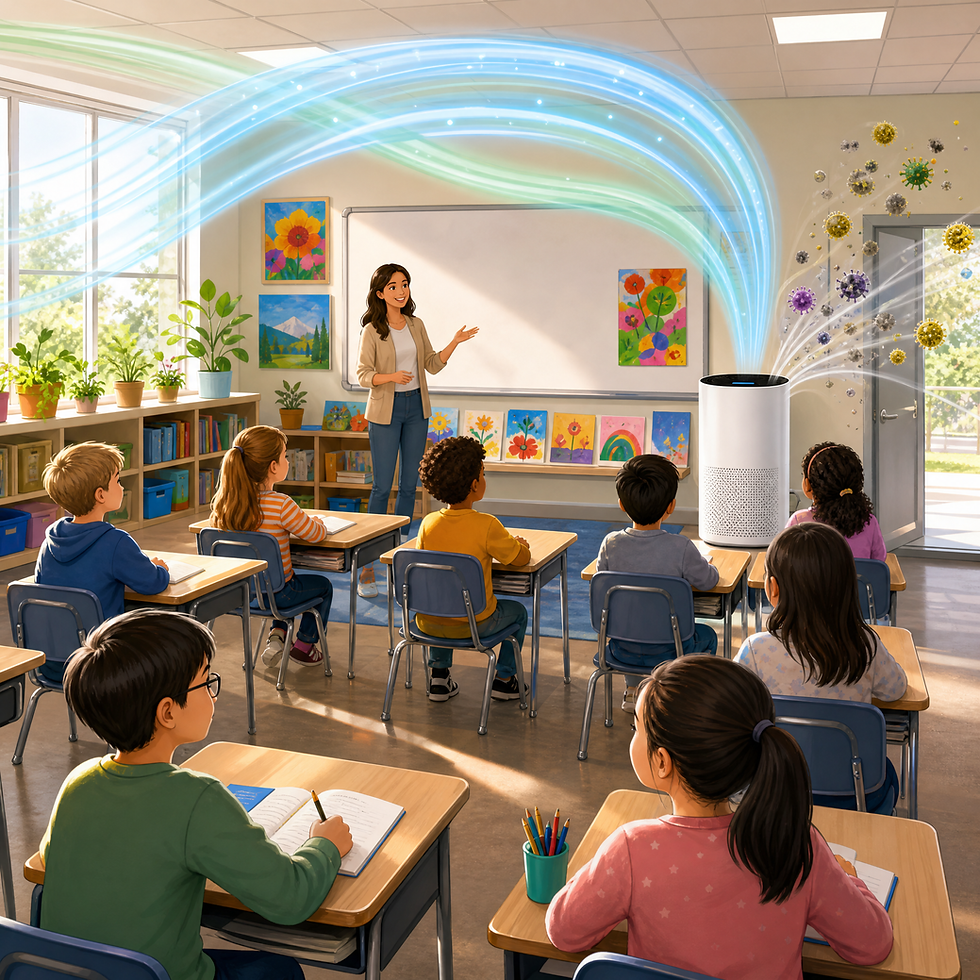
If you have a child who comes home from school tired, congested, and struggling to concentrate during what should be their peak learning years, the air inside their classroom could be part of the problem. Schools across the United States are increasingly recognized as high-risk indoor air quality environments, with overcrowded classrooms, aging HVAC systems, high allergen loads, and the constant sharing of air between dozens of children creating conditions that are difficult to keep clean without active filtration. A properly sized Air purifier for classroom running continuously throughout the school day can reduce allergen, pollutant, and airborne pathogen levels to a degree that measurably improves both the health and the academic performance of every student in the room.
Poor Classroom Air Quality and Its Effect on Learning
The connection between indoor air quality and academic performance is now well-established in scientific research, and the findings are striking. Studies have consistently found that students in classrooms with poor air quality, elevated CO2 levels, high allergen concentrations, and inadequate ventilation score lower on tests, have shorter attention spans, and take significantly more sick days throughout the school year. New 2026 research cited by allergy tracking organizations found that every increase of 10 pollen grains per cubic meter in a classroom can lead to a measurable reduction in student examination scores, particularly in mathematics. Allergy-related brain fog can reduce overall student focus by 10 to 15 percent. According to Wikipedia's article on indoor air quality, poor ventilation and elevated indoor pollutant levels in educational settings are directly linked to increased absenteeism, reduced cognitive function, and greater incidence of respiratory illness among both students and teachers. For schools that are genuinely serious about educational outcomes, improving classroom air quality is not a peripheral concern, it is a core investment in the conditions that make learning possible.
What Makes Classrooms Such a Challenging Air Environment
Classrooms present an unusually demanding set of air quality challenges that most standard HVAC systems were never designed to handle on their own. Thirty or more students sharing a single room for six or more hours a day generates significant quantities of exhaled CO2, airborne bacteria and viruses, and biological aerosols that accumulate rapidly in a poorly ventilated space. Dust from chalk, whiteboard markers, craft materials, and general foot traffic from outdoor to indoor spaces brings allergens and fine particulate matter into the classroom environment constantly throughout the day. In older school buildings, aging HVAC systems may circulate allergens, mold spores, and dust between rooms rather than filtering them out. A dedicated Classroom air purifier with True HEPA filtration running continuously addresses all of these particle-based threats in real time, capturing allergens, dust, mold spores, and biological aerosols before they can build up to levels that affect health and concentration throughout the school day.
Protecting Teachers as Well as Students
It is easy to focus entirely on students when discussing classroom air quality, but teachers and school staff spend even more hours in these spaces and face the same, and in some cases greater, health risks from poor indoor air. Teachers who develop respiratory infections from classroom air exposure miss work days, reducing continuity and quality of education for their students. Teachers with allergies or asthma may find that classroom conditions actively worsen their symptoms throughout the school year, affecting their energy levels and their ability to perform at their best. Investing in quality air purifiers for schools benefits every person in the building, from students through to administrators, and signals a genuine commitment to the health and wellbeing of the entire school community. Schools that have installed air purifiers report not just improvements in student health metrics but also reductions in teacher sick days, which has a direct and quantifiable positive impact on educational delivery and school budget.
What to Look for in a School or Classroom Air Purifier
Choosing the right air purifiers for schools requires balancing several factors that are specific to an educational environment. Coverage area and CADR rating must be appropriate for the square footage of a typical classroom, which in most US schools ranges from 700 to 1,000 square feet. The unit must operate quietly enough not to disrupt teaching, ideally below 50 decibels at mid-fan speed so teachers and students can speak and listen normally throughout the day. Durability and ease of filter replacement are important for school environments where maintenance resources are limited and the unit needs to run reliably for years without issues. Units should carry CARB certification confirming they are ozone-free, and AHAM Verifide certification confirming their CADR performance claims. According to Wikipedia's article on HEPA filtration, True HEPA filtration at a minimum capture efficiency of 99.97 percent is the gold standard for removing the fine airborne particles that cause the most significant health and cognitive effects in shared indoor spaces like classrooms.
Better Air, Better Learning, Starting Right Now
The investment in a quality air purifier for a school classroom is one of the most cost-effective health and educational interventions a school district can make. The cost of a single well-chosen classroom air purifier is a fraction of the cost of a single teacher sick day, and a fraction of the cost of the educational disruption caused by students missing school due to allergy and respiratory illness. Parents who are frustrated by their children coming home sick, unfocused, or congested after school days can advocate for purifiers in their children's classrooms by sharing the growing body of research linking air quality to educational outcomes. And school administrators who want to make a visible, tangible commitment to student and staff wellbeing have a clear and accessible tool available to them right now. Explore purpose-built, quiet, powerful Air purifier for classroom solutions designed specifically for the shared indoor environments of schools, and take the most meaningful and immediately impactful step available toward a school where every child and every teacher can breathe clearly, focus fully, and perform at their very best every single day.

Comments